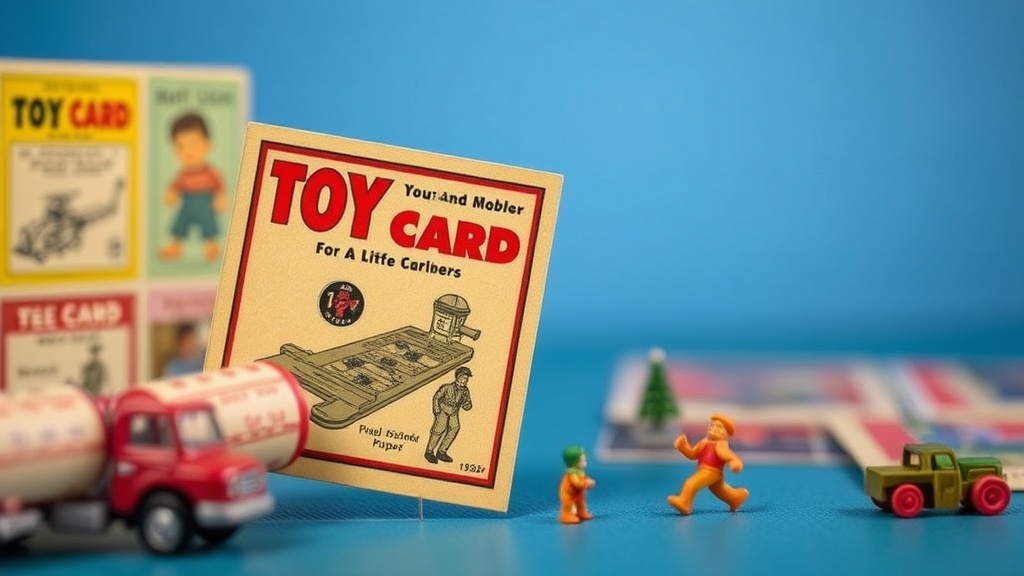
Toy Trade Cards: The Pocket-Sized Paper That Predates Your Entire Catalog Collection

Most collectors assume the history of toy advertising begins with the thick holiday catalogs we remember from childhood—or the glossy department store tomes of the 1950s. That's a mistake. Long before the first Sears Wish Book landed on a doorstep, toy manufacturers were already mastering the art of promotion through small, vividly illustrated cards that fit in a pocket. These trade cards—handed out at counters, tucked into product packaging, and mailed directly to homes—represent the true foundation of toy marketing. They're also one of the most overlooked categories in paper collectibles today.
Toy trade cards emerged in the late 19th century when lithography became affordable enough for mass production. Companies like McLoughlin Brothers, Milton Bradley, and Parker Brothers distributed these cards to promote everything from board games to mechanical toys. Unlike catalogs, which required significant investment to print and distribute, trade cards were cheap to produce and easy to hand out. A child might receive one with a toy purchase, or a parent might find one inserted into a newspaper. The cards served as both advertisement and keepsake—and that's precisely why they've survived in attics and estate sales for well over a century.
What makes trade cards particularly fascinating is their dual nature. They're commercial artifacts, yes—but they're also miniature works of art. Printers competed to produce the most eye-catching designs, often using elaborate chromolithography techniques that made each card a small masterpiece. The imagery tells us what childhood meant to Victorian and Edwardian society: idealized play scenes, moral lessons wrapped in entertainment, and the emerging consumer culture that would eventually define American childhood. For collectors who care about context as much as acquisition, trade cards offer something catalogs rarely can—the immediate, unfiltered voice of an era's marketing machine.
What Exactly Are Toy Trade Cards and Where Did They Come From?
Trade cards descended from the broader tradition of advertising cards that flourished between the 1870s and 1900s. Before television, before radio, before even widespread magazine advertising, businesses relied on these small paper items to build brand recognition. A typical toy trade card measured roughly 3 by 5 inches—small enough to tuck into a pocket or paste into a scrapbook. The front featured a colorful illustration, often depicting children at play or the toy itself in action. The reverse carried promotional copy, pricing information, or sometimes nothing at all.
The golden age of toy trade cards roughly coincides with the rise of the American toy industry itself. McLoughlin Brothers, founded in 1828 but hitting its stride in the 1880s, produced some of the most sought-after cards in today's market. Their "Games of Life" series and promotional materials for optical toys (like the zoetrope) are particularly prized. Parker Brothers, still a household name today, issued trade cards promoting their early board games—some of which survive as the only visual record of products that otherwise disappeared without a trace.
These cards weren't merely disposable advertising—they were collectible even when new. Children actively traded them, pasted them into albums, and treated them as prized possessions. This explains their surprising survival rate despite their fragile paper construction. A card that entered a child's scrapbook in 1890 might remain pressed between acidic pages for decades, protected from light and handling damage. When those albums surface at estate sales today, collectors encounter time capsules of Victorian visual culture.
The subject matter ranged widely. Some cards showed the toy in use—children rolling hoops, playing with mechanical banks, or assembling block sets. Others used humor, depicting comical scenes that might loosely connect to the product. Still others borrowed from popular culture: nursery rhyme characters, circus performers, or exotic animals. The variety means there's something for nearly every collecting interest, from those focused on specific toy categories to those drawn to particular artistic styles or historical periods.
Where Can You Find Authentic Vintage Toy Trade Cards Today?
Finding trade cards requires a different approach than hunting catalogs. You won't typically find them at book fairs or antique paper shows dominated by rare volumes. Instead, they surface in the informal economy of estate sales, online auctions, and specialty ephemera dealers. eBay remains the most active marketplace, with hundreds of listings at any given time—though quality varies dramatically from damaged commons to pristine rarities. The key is learning to distinguish authentic period pieces from modern reproductions.
Authentication starts with understanding printing techniques. Genuine 19th-century trade cards used chromolithography, a process that layered multiple colors through separate stone impressions. This creates distinct visual characteristics: slightly raised ink, rich color saturation, and the occasional registration error where colors don't align perfectly. Modern reproductions typically use digital printing or offset lithography—the colors sit flat on the paper, and the overall effect lacks the depth of genuine chromolithography. The paper itself tells a story too. Period cards used cardstock that aged predictably: yellowing at the edges, developing a particular brittleness, sometimes showing foxing (those brown spots caused by acid migration).
Specialty dealers offer a more curated experience than general auction platforms. The Ephemera Society of America maintains a directory of reputable dealers and hosts an annual fair that's worth attending if you're serious about building a collection. Their membership includes specialists in advertising materials who can source specific cards or alert you when rarities surface. Major auction houses like Heritage Auctions occasionally include trade card lots in their Americana and political memorabilia sales, particularly when the cards connect to significant manufacturers or historical events.
Don't overlook local resources. Historical societies in former manufacturing centers—Springfield, Massachusetts (home to Milton Bradley); Salem, Massachusetts (Parker Brothers); and New York City (McLoughlin Brothers)—sometimes hold trade cards in their collections. While most institutions won't sell, they may provide reference images or documentation that helps you authenticate pieces in your own collection. The Library of Congress has digitized thousands of trade cards as part of their broader ephemera collection, offering a free research resource for identifying unknown pieces.
How Should You Store and Display Paper Trade Cards?
Trade cards present unique preservation challenges. Their small size makes them easy to store—but also easy to damage through careless handling. The paper is often thinner than postcard stock, and the colorful lithographed surfaces can be surprisingly fragile. If you're coming from catalog collecting, where the goal is often keeping volumes on shelves, you'll need to adjust your thinking. These items demand archival treatment from the moment they enter your collection.
Start with individual protection. Each card should reside in its own polyethylene or polyester sleeve—not PVC, which off-gasses chemicals that accelerate deterioration. Standard trading card sleeves work for many pieces, though larger cards may require specialty sizes. For long-term storage, consider placing sleeved cards in archival boxes with acid-free dividers. The boxes should live in a cool, dry environment away from direct light. Basements and attics are out—temperature fluctuations and humidity spikes wreak havoc on paper.
Displaying trade cards offers more options than you might expect. Their small size actually works in your favor here. You can frame groupings thematically—by manufacturer, by subject matter, or by color palette—creating visual narratives that would be impossible with larger materials. Use UV-filtering glass or acrylic, and keep framed pieces out of direct sunlight. Some collectors prefer to rotate their displays, keeping the majority in storage and bringing out selections for limited periods. This approach balances enjoyment with preservation.
Condition grading for trade cards hasn't standardized the way it has for baseball cards or comic books, but most dealers use a variation of the standard scale: Near Mint, Excellent, Very Good, Good, and Fair. Unlike those other collectibles, though, trade cards often show their age charmingly. Minor corner wear or slight toning doesn't necessarily diminish a card's historical value or visual appeal. What you want to avoid are major creases, significant staining, or paper loss—these damage types suggest poor storage or handling and can substantially reduce value.
Which Toy Trade Card Themes Hold the Most Collector Interest?
Certain thematic categories consistently attract collector attention—and premium prices. Mechanical bank trade cards rank among the most valuable, partly because the banks themselves command such strong markets. Cards produced by the J. & E. Stevens Company or Shepard Hardware Company can sell for hundreds of dollars when in excellent condition. The connection to a desirable three-dimensional collectible creates crossover demand that drives prices upward.
Optical toy cards—promoting zoetropes, phenakistoscopes, and other pre-cinematic devices—appeal to collectors interested in the history of visual media. These cards often feature abstract designs or sequential images that demonstrate the optical principles behind the toys. They represent a fascinating intersection of scientific education and entertainment marketing. McLoughlin Brothers dominated this niche, and their optical toy cards remain identifiable by their distinctive artistic style and heavy cardstock.
Holiday-themed trade cards offer accessible entry points for new collectors. Christmas scenes appear frequently, as manufacturers timed their promotional pushes for the holiday shopping season. These cards sometimes depict Santa Claus in his various historical guises—from the thin, stern figure of early American illustration to the rounded, jolly character popularized by Coca-Cola advertising. The visual evolution of holiday iconography, captured in miniature on these cards, provides documentary value beyond their status as toy advertisements.
Don't overlook what dealers call "occupation cards"—images showing children pretending at adult work. These cards promoted toy sets that mimicked real-world trades: blacksmithing, cooking, carpentry, nursing. They're sociologically fascinating, revealing what adults thought children should aspire to (or be entertained by). The gender divisions are often stark and uncomfortable to modern eyes, but they're historically honest documents of their era's values.
How Do Trade Cards Fit Into a Broader Paper Collecting Strategy?
Smart collectors think about relationships between materials. Trade cards don't exist in isolation—they connect to catalogs, to product packaging, to newspaper advertising, to the toys themselves. A complete collection might include the trade card that promoted a particular game, the box that game came in, the instruction sheet inside, and the game components themselves. Each piece of paper tells part of the story.
This holistic approach distinguishes serious collectors from accumulators. Anyone can buy random cards that catch their eye. The collector who understands context—who can explain why a particular McLoughlin Brothers card from 1885 matters to the history of American board games—is building something with scholarly as well as monetary value. That depth of knowledge also protects you in the marketplace. Dealers recognize educated buyers and are less likely to misrepresent condition or authenticity.
Trade cards also serve as affordable entry points for collectors priced out of the catalog market. A genuine 1890s toy catalog in good condition might cost hundreds or thousands of dollars. A trade card from the same manufacturer, produced the same year, might cost twenty dollars. You're holding a piece of the same history, created by the same printers, distributed by the same company—for a fraction of the investment. As you build knowledge and confidence, you can gradually pursue rarer pieces.
The community of trade card collectors is smaller and more specialized than the general toy collecting world, but that has advantages. You'll find genuine expertise at shows and in online forums. People remember pieces they've seen decades ago. They're generous with information because the field isn't overrun with speculators. Join the Ephemera Society, subscribe to their newsletter, and attend their events. The connections you make will prove as valuable as any individual acquisition.
Ultimately, toy trade cards offer something increasingly rare in collecting: an accessible, historically significant category where discovery is still possible. While everyone chases the same few famous catalogs, trade cards wait in shoeboxes at estate sales, hide in lots of "miscellaneous paper," and surface in unexpected places. The collector who understands their value—who recognizes that these small rectangles of printed paper launched an industry—holds a special kind of knowledge. It's the knowledge that collecting isn't about size or volume. It's about the stories we choose to preserve.