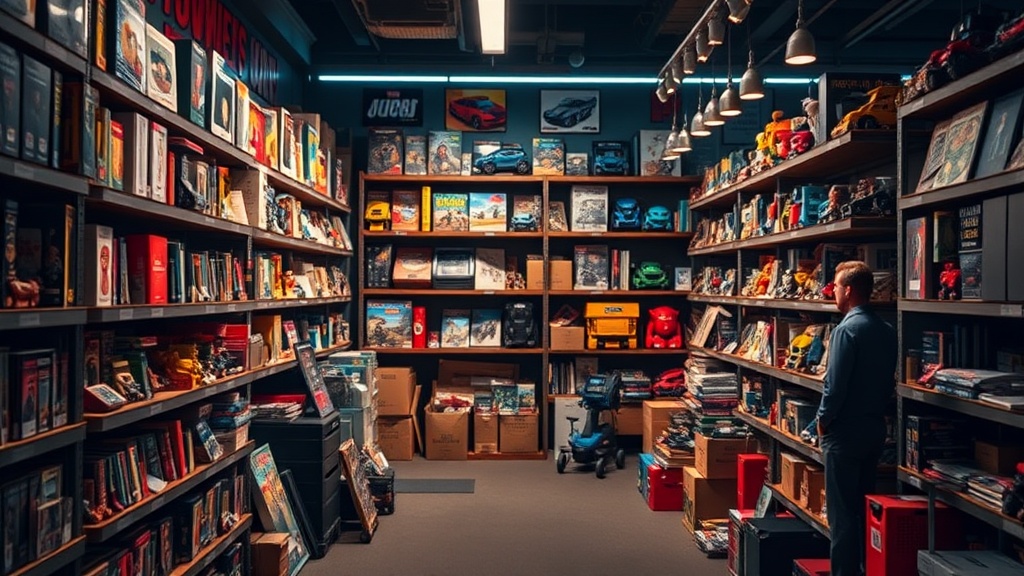
How to Build a Working Inventory System for Your Toy Catalog Collection

Most collectors assume alphabetical order—or sorting by year—is enough to keep their toy catalogs organized. It isn't. Without a proper inventory system, you'll waste hours hunting for that 1982 Sears Wish Book you know you own, or worse—buy duplicates of catalogs already sitting on your shelf. A working catalog of your catalogs doesn't just save time; it transforms how you research, buy, and enjoy your collection.
Here's how to build an inventory system that actually works—one you'll maintain instead of abandoning after a weekend of good intentions.
Should I Track My Collection Digitally or on Paper?
Both methods have their place—and the best systems often use both.
Digital tracking wins for searchability and backup security. A simple spreadsheet works fine for under 200 catalogs. Excel, Google Sheets, or even Airtable (my personal preference for larger collections) let you filter by publisher, year, condition, or acquisition date in seconds. You can attach photos of condition issues, link to purchase receipts, and access everything from your phone while standing in an estate sale.
Paper catalogs—ironically—still matter for toy catalog collectors. A physical binder with printed inventory sheets becomes your "in-case-of-emergency" backup if cloud services fail. More importantly, paper creates a different kind of engagement. There's something about flipping through handwritten acquisition notes that triggers memories digital entries can't replicate. (I still remember where I found my 1967 Montgomery Ward Christmas catalog because I jotted "basement of that cluttered house on Connolly Street" in the margin.)
The hybrid approach works best: maintain your master inventory digitally for daily use, but print quarterly summaries that live in a three-ring binder. Update the paper version every few months—it's surprisingly satisfying to see your collection's growth in physical form.
What Information Should Every Catalog Entry Include?
Resist the urge to track everything. Overly complex systems fail because maintaining them feels like punishment.
Start with these core fields:
- Catalog title (include year and season if applicable)
- Publisher/manufacturer (Sears, Montgomery Ward, Mattel, etc.)
- Page count (helps identify complete vs. partial copies)
- Condition grade (use standard book terms: Fine, Very Good, Good, Fair, Poor)
- Date acquired and source (dealer, estate sale, eBay, trade)
- Storage location (Box A, Shelf 3, Flat file drawer—be specific)
- Notable contents (hot toys featured, exclusive items, famous ads)
Optional fields worth considering: estimated value (update annually), whether you've scanned or photographed it, and cross-references to related catalogs in your collection. That last one proves surprisingly useful—linking your 1978 Sears Wish Book to the 1979 edition helps you spot patterns in toy line evolution.
One warning: don't get obsessive about perfect condition grades. "Very Good minus" vs. "Good plus" distinctions create decision fatigue. Pick broad categories and stick with them. Your future self will thank you when updating the inventory doesn't require fifteen minutes of internal debate.
How Do I Organize Physical Storage to Match My Inventory?
Your digital system is useless if your physical storage doesn't align with it. I've seen collectors with beautiful spreadsheets who still can't locate specific catalogs because their boxes are labeled "Misc. 1970s Stuff."
For collections under 100 catalogs, chronological order within broad categories works well. Group by publisher first (all Sears together, all JCPenney together), then by year. This mirrors how researchers typically look for material—"I need to see what Mattel advertised in 1985."
Larger collections benefit from location-based storage. Number your boxes or bins clearly—Box 001, Box 002—and let your inventory track which box holds what. This decouples physical arrangement from logical organization. Your 1980s Wish Books might live in Box 003 and Box 017 based on size and available space, but your spreadsheet knows exactly where each one lives.
Protective storage deserves serious attention. Polyethylene bags prevent handling damage and keep dust off fragile covers. Archival-quality boxes—available from suppliers like Gaylord Archival—buffer against humidity swings better than cardboard. Never store catalogs in direct sunlight or damp basements; paper ephemera is surprisingly sensitive to environmental conditions. The Library of Congress preservation guidelines offer excellent guidance on proper storage temperatures and relative humidity levels.
Flat storage beats vertical shelving for thick seasonal catalogs. Standing heavy catalogs on their spines creates stress that eventually cracks bindings. Large format toy catalogs—those oversized department store Christmas books—need flat storage in shallow drawers or acid-free boxes.
How Often Should I Update My Inventory?
More frequently than you think—but not so often it becomes burdensome.
New acquisitions should enter your system within 48 hours. The longer you wait, the more details fade. Where did you buy it? What did you pay? Was there condition information you noticed? Capture this immediately while the context is fresh.
Schedule quarterly reviews for the full collection. This sounds excessive until you realize how much information accumulates in three months. You may have moved catalogs during research. Maybe you noticed a previously unrecorded tear. Perhaps you finally scanned that rare 1950s catalog and need to note the digital file location. Fifteen minutes every three months prevents a disastrous backlog.
Annual deep audits matter too. Once a year, pull every catalog and verify it matches your inventory. Check condition grades—paper deteriorates gradually, and your "Very Good" from three years ago might have become "Good" through normal aging. Update values if you track them. Confirm storage locations haven't drifted through casual browsing.
Some collectors gamify this process. Challenge yourself to photograph ten catalogs per month, or to write condition notes for five. Small, consistent actions beat heroic marathon sessions that burn you out.
What Are the Most Common Inventory Mistakes to Avoid?
After fifteen years of collecting—and talking with dozens of other toy catalog enthusiasts—I've noticed the same errors recurring.
Vague location codes wreck otherwise excellent systems. "Basement" isn't a location; "Basement, shelf 2, blue bin" is. Be ruthlessly specific. Your memory isn't as reliable as you believe, especially after hundreds of acquisitions.
Inconsistent naming conventions make searching impossible. Decide early: is it "Sears Wish Book 1982" or "1982 Sears Wish Book" or "Wish Book, Sears, 1982"? Pick a format and apply it religiously. Spreadsheets have powerful search functions—but only if your data follows predictable patterns.
Neglecting to record provenance erases historical value. Who owned this catalog before you? Was it a promotional copy? Did it come from a specific retail location? These details seem trivial until they become fascinating. The estate of a former toy buyer contains very different material than random household accumulation.
Over-complicating early kills momentum. Start simple. You can always add fields later. A basic spreadsheet you actually maintain beats an elaborate database you abandon after a month.
Finally, don't forget to back up digital inventories. Cloud storage is cheap; losing your catalog of catalogs is expensive in time and frustration. Google Sheets auto-saves. Excel can sync to OneDrive. Export CSV files quarterly and store them somewhere separate. Paranoia about backups is a virtue in collecting.
"The best inventory system is the one you'll actually use." — Every experienced catalog collector, eventually
Building a functional inventory system for toy catalogs isn't glamorous work. It lacks the thrill of acquisition or the joy of discovery. But it enables both. When you know exactly what you own—and where it lives—you can research more deeply, buy more intelligently, and display more proudly. Your collection deserves better than chaos.
Start today with whatever you have. Ten catalogs or ten thousand—the principles remain identical. Document what you own. Store it carefully. Update regularly. The system you build will outlast any individual catalog in your care—and that's the true measure of a serious collector.